

Selecting the right CNC machine for small businesses requires assessing production needs, material types, precision requirements, budget including maintenance and tooling costs, and workspace compatibility. Popular options include benchtop mills/routers for prototyping, entry-level lathes for cylindrical parts, plasma/laser cutters for sheet metal, and desktop 3D printers for rapid prototyping. Key features include user-friendly interfaces, CAD/CAM software compatibility supporting standard file types, comprehensive warranty coverage, and responsive technical support. Total cost considerations extend beyond purchase price to include training, power consumption, and ongoing maintenance. Yijin Hardware in Homestead, FL provides equipment consultation, site assessments, onboarding guidance, and comprehensive service agreements for small businesses across automotive, aerospace, and medical sectors.
Key Takeaways
- Choosing the right CNC machine for small businesses ensures increased efficiency and consistent product quality.
- Assess your production needs, material requirements, and desired precision before selecting a CNC machine.
- Consider total costs including purchase price, maintenance, tooling, and training to determine ROI.
- Evaluate machine size and workspace compatibility to ensure a smooth integration into your facility.
- Prioritize ease of use, compatible software, and reliable support when selecting a CNC machine.
- Partnering with experienced providers like Yijin Hardware can simplify decision-making and provide valuable after-sales support.
Understanding CNC Machines: Types and Capabilities
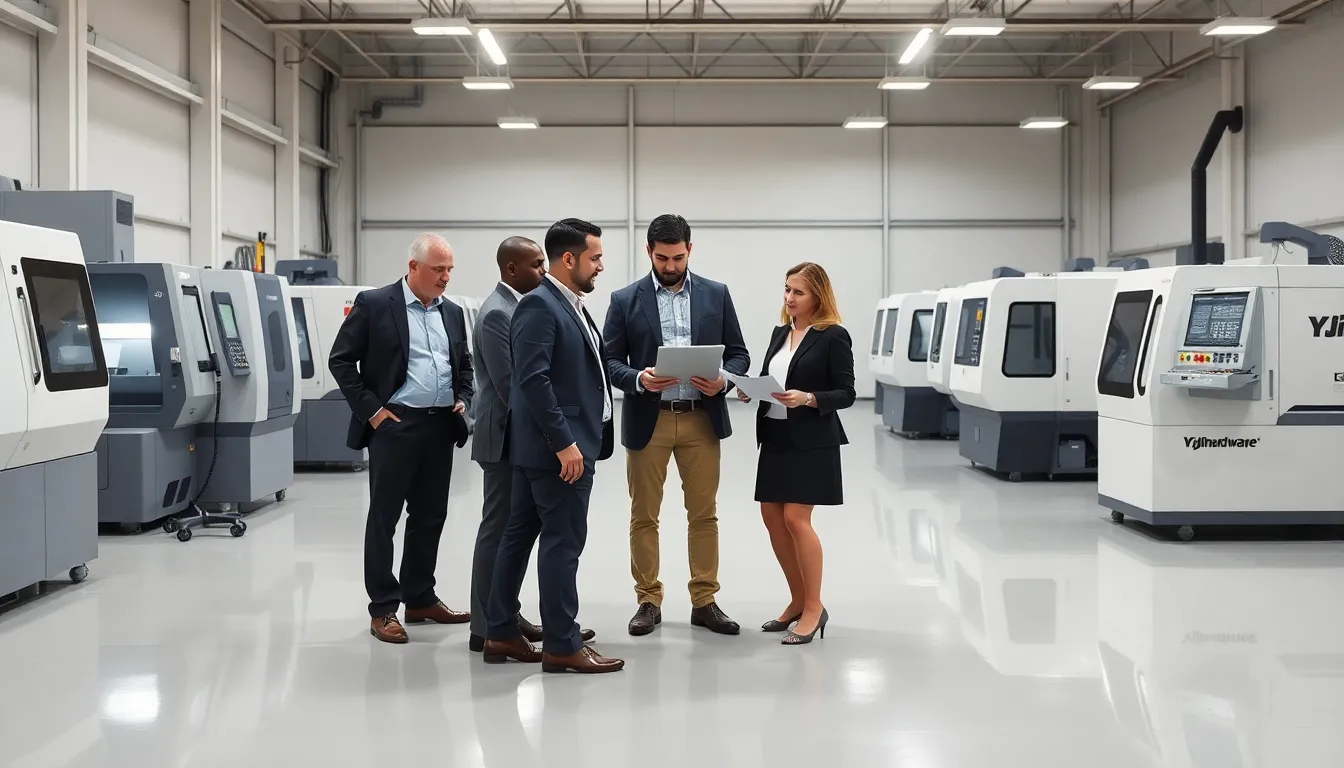
CNC (Computer Numerical Control) machines automate the shaping and assembly of parts, relying on programmed software to control tools and movements. For small businesses, the main benefit is consistent accuracy at production speeds that would be nearly impossible by hand. There are several types of CNC machines, each designed for specific fabrication tasks:
- CNC mills are ideal for cutting and drilling metal, plastic, or wood parts to precise specifications. They’re commonly used for prototyping and smaller production runs.
- CNC lathes spin a workpiece and use cutting tools to shape it: great for cylindrical parts like shafts, fasteners, and bushings.
- CNC routers excel at quickly cutting softer materials (wood, plastics, composites) and are popular with sign makers, cabinet shops, and model makers.
- CNC plasma and laser cutters use high-energy beams or plasma arcs to make intricate cuts, often on sheet metal. They’re well-suited for decorative designs or specialized industrial pieces.
- CNC 3D printers build objects from digital files by layering plastic, metal, or resin.
When selecting a CNC machine, understanding its capabilities versus your specific job requirements is essential. Yijin Hardware, based in Homestead, FL, provides access to a broad range of modern CNC equipment, making them a trusted partner for businesses aiming to scale up quickly and efficiently.
Key Factors Small Businesses Should Consider
Assessing Business Needs and Production Goals
No two shops are alike. Start by defining what your business needs to accomplish: Are you producing complex one-off prototypes, short production runs, or standardized components in higher volumes? The complexity, material type, and tolerance requirements for your parts will help determine the suitable machine type and required accuracy. For example, medical and aerospace work demands higher precision and consistent repeatability, often pointing toward advanced CNC milling machines or multi-axis solutions.
Yijin Hardware’s expertise serving automotive, aerospace, and medical sectors demonstrates the value of matching machine technology to industry requirements. Companies can consult with their team to clarify any uncertainties about tolerances, turnaround, and adaptability.
Budget and Return on Investment
A CNC machine is a capital investment. Beyond the upfront cost, consider recurring expenses like tooling, maintenance, power consumption, and training. Examine the expected output, how many parts must you produce weekly or monthly to justify the cost? Calculate your break-even point by factoring in labor savings, reduced scrap, and improved quality. Many successful small businesses in Homestead report meaningful ROI by switching to automation for recurring tasks.
Machine Size, Power, and Workspace Requirements
Space makes a difference: Will the chosen machine physically fit within your shop? Some CNC mills and lathes require specific floor reinforcements or climate control, and all need sufficient power supply. Don’t overlook practical constraints such as operator access, ventilation, or chip/dust management. The team at Yijin Hardware can help small businesses make informed choices, conducting site assessments to recommend machines compatible with your available space and resources.
Comparing Popular CNC Machine Types for Small Businesses
For small businesses, versatility and efficiency are often top priorities. Here’s a straightforward comparison of popular CNC machine options:
- Benchtop CNC mills and routers: Compact and relatively affordable, these are perfect for prototyping, custom work, or low-volume runs. They fit on a sturdy table and usually run on single-phase power, making them attractive for startups.
- Entry-level CNC lathes: Designed for light- to medium-duty cutting, they’re good for parts like bushings, valves, or simple medical devices. Some offer quick-change chucks and programmable tool turrets for flexibility.
- Plasma and laser cutters: These are compact enough for fabrication shops and are especially useful for precise sheet metal or sign cutting. They tend to have lower ongoing maintenance needs compared to larger machines.
- Desktop CNC 3D printers: Great for rapid prototyping or specialty plastics. While they can’t match the speed of larger subtractive machines, their versatility in geometry is unmatched.
Each type offers tradeoffs between speed, cost, and capability. Before committing, reach out to a local manufacturer like Yijin Hardware to see sample parts or tour an operational facility: seeing machines in action helps clarify which models align with your company’s needs and budget.
Essential Features to Look For
Ease of Use and Training Requirements
Small businesses benefit from machines that are easy to set up and operate. Modern CNC machines often include user-friendly graphical interfaces, intuitive controls, and built-in safety systems. Before purchase, ask how much training is required. Yijin Hardware, for example, provides onboarding guidance and ongoing support, helping clients get up to speed quickly and minimize costly learning curves.
Software Compatibility and Integration
Check that the CNC system you’re considering is compatible with your existing CAD/CAM software. Some entry-level machines use proprietary software, which could limit integration with other tools or lead to extra licensing costs. Look for systems that support standard file types (such as STEP, DXF, or STL) and allow for easy upgrades. Yijin Hardware’s specialists can advise on setup strategies and compatible software ecosystems, ensuring smooth transitions and uninterrupted production runs.
Maintenance, Support, and Warranty Considerations
A high-quality CNC machine should be reliable, and when unexpected downtime happens, responsive support is critical. Evaluate what kind of technical support, parts availability, and warranty backing comes with each machine. Some manufacturers only offer phone support, while others (like Yijin Hardware in Homestead, FL) provide on-site repair, remote diagnostics, and operator training.
Ask about warranty coverage periods, what routine maintenance tasks are required, and whether local spare parts are available. Good support can keep a small shop running smoothly, saving valuable time and protecting your investment. Yijin Hardware stands behind their equipment and includes comprehensive service agreements so businesses can focus on orders, not repairs.
Yijin Hardware
Yijin Hardware offers a range of precision manufacturing services, including CNC machining, sheet metal fabrication, and custom fasteners. They also provide additional solutions such as die casting, injection molding, and 3D printing to support various industries like automotive, aerospace, medical, and energy.
Contact:
Gavin Yi, CEO
Phone: +1 626 263 5841
Email: [email protected]
Website: www.yijinsolution.com
Location:
760 NW 10th Ave, Homestead, FL 33030
Frequently Asked Questions About Choosing a CNC Machine for Small Businesses
What are the key factors to consider when choosing a CNC machine for small businesses?
Small businesses should assess their production needs, material types, required precision, workspace, machine size, ongoing maintenance, and software compatibility to select the CNC machine that best matches their goals and budget.
How does the type of CNC machine affect small business operations?
The type of CNC machine—such as mills, lathes, routers, plasma cutters, or 3D printers—determines the materials you can process, the part complexity, and the speed of production, all of which influence operational efficiency and product quality for small businesses.
Why is software compatibility important when buying a CNC machine?
Software compatibility ensures seamless workflow between design and production stages. Choosing a CNC machine that supports standard CAD/CAM file types allows for easy upgrades and integration, reducing extra software costs and minimizing compatibility issues.
What maintenance and support should small businesses expect with a new CNC machine?
A reliable CNC machine should come with solid warranty coverage, technical support, parts availability, and training. Look for vendors that offer responsive on-site or remote support to ensure minimal downtime and long-term productivity.
What is the average cost of a CNC machine for a small business?
The price of a CNC machine for small businesses varies widely based on the type, size, and capabilities. Benchtop models may start around $5,000, while advanced or larger machines can exceed $50,000. It’s essential to also factor in ongoing costs like maintenance and tooling.
Can a small business benefit from used CNC machines?
Yes, purchasing a used CNC machine can be cost-effective for small businesses if the machine is in good working condition and supported by reliable warranty and service options. Always inspect the equipment and verify support availability before buying.
